

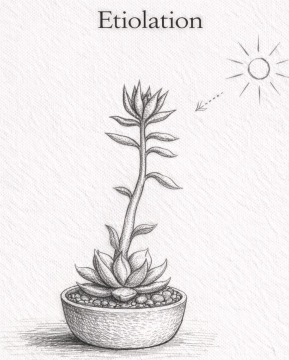
Why do succulents stretch and how can I fix it? This is probably the most common question asked by beginners. Let's explore why succulents stretch, how to prevent it, and what to do to correct the appearance of an already stretched plant.
What to do if succulents have stretched
If succulents have stretched over the winter, it happens to everyone, and you can correct the situation in the following ways:
1. Cut off and root the top of the stretched plant.
2. Replant offshoots, shoots, or root leaf cuttings.
Succulent stretching, or "etiolation," as it's known scientifically, is the discoloration of a shoot and its abnormal elongation and weakening due to underdevelopment of the leaves due to insufficient light, such as indoors or in densely populated plants. In the case of succulents, this is specifically due to insufficient light, as stretching most often occurs in winter. This is further promoted by overwatering or excessively high temperatures, which together stimulate plant growth. And everything would be fine if there was enough light—the plant would grow vigorously and develop as expected, but with insufficient light, we experience stretching, loss of shape, and beauty...
Why does succulent stretching most often occur indoors? It's for the same reason. While succulents in the conservatory overwinter dryly and at temperatures of 5-10 degrees Celsius, in our room, with a radiator, the temperature rarely drops below 25 degrees Celsius, the plant "thinks" it's time to grow faster... Plus, we worry about the plant not getting enough moisture, so we water it more often than necessary.
How to Prevent Succulents from Elongating
So, we've more or less figured out what causes succulents to stretch. Now let's talk about how to avoid it or correct an already elongated plant.
To slow down the growth of succulents during the dark season, move them to a cool place. Move them from a warm room to a veranda or insulated balcony, where it will be cool but the plants won't freeze. Some hobbyists find a solution by placing pots between frames. Another option is to move the pots as close to the glass as possible and shield them from the warm, dry air of radiators. And, of course, reduce watering to a minimum. A cool, dry overwintering is the easiest and cheapest way to prevent succulents from stretching.
The second option is to provide additional lighting. Supplemental lighting will help maintain the compact shape of succulents until spring. Don't expect one wretched energy-saving lamp or LED strip to solve the problem. Don't be fooled—they won't. Succulents are very light-loving, so I recommend choosing professional plant lights with the highest wattage possible for your conditions. If you only have room for a frail 18-watt DSKI, consider the first option—a dry, cool overwintering.
In summary, I'd like to emphasize that it's easier to prevent stretching than to deal with its consequences. However, if succulents have stretched, it's not a big deal; it's a reason to reflect and "correct your mistakes," while also gaining valuable experience in propagating these resilient and tenacious plants.